Living Bog Archive
Transforming fragmented cultural knowledge into an accessible digital archive.
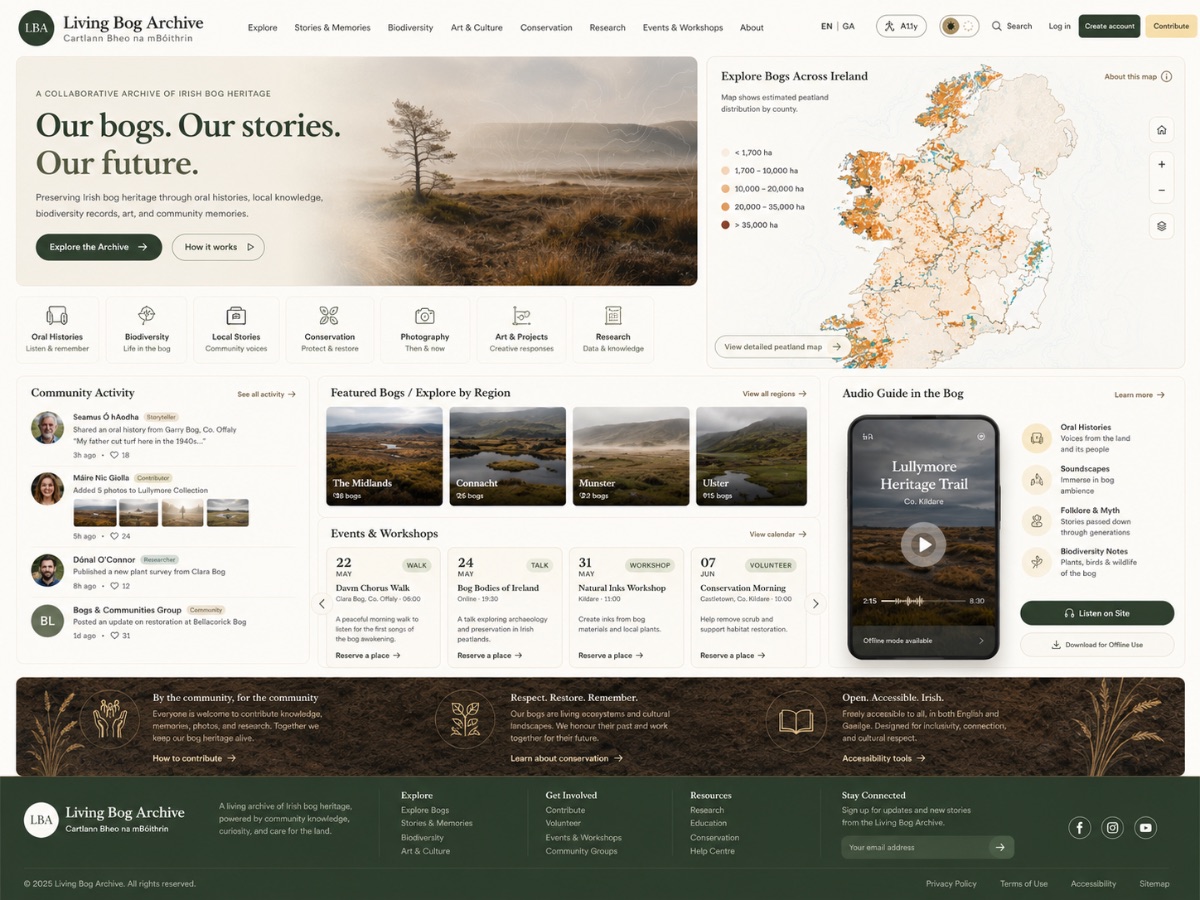
The Living Bog Archive is a cultural and educational platform documenting Ireland's raised bogs, landscapes that are ecologically vital and culturally rich, yet often fragmented across multiple sources and organisations.
The project explores how information architecture, editorial design and AI-assisted methods can help transform complex knowledge into an accessible and engaging digital experience, a community-led archive spanning heritage, biodiversity, oral histories, culture, research, events and conservation.
Designer and researcher throughout the entire project, from early discovery and structure through to a prototyped final design.
This project was developed as part of the AI for Designers postgraduate programme at TU Dublin.
The challenge was not only to design a website, but to explore how AI tools could be integrated into a human-centred design process, while keeping critical judgement and responsible decision-making firmly in human hands.
Existing cultural archives often prioritise retrieval over understanding. Users can search for information, but struggle to see the relationships between places, biodiversity, stories, people and heritage.
The challenge was to create a structure that lets newcomers discover and learn, rather than simply search.
“The information exists somewhere. What's missing is a structure that helps people understand why it matters.”
Create a clear structure for exploring Irish bog heritage.
Support stories, biodiversity, culture and research in a single ecosystem.
Balance AI-assisted design with human judgement.
Design an archive that can grow over time without losing clarity.
I began by studying how cultural archives are structured and where they tend to fail their audiences, pairing that with desk research into the bogs themselves.
- Analysis of existing heritage and cultural archives and their navigation patterns.
- Information-architecture research into how people browse unfamiliar subjects.
- Review of community-contribution systems that keep an archive growing.
- Desk research into Irish raised bogs, ecology, history and cultural significance.
Users navigate through stories before metadata.
Discovery matters more than search for newcomers.
Cultural archives require context, not just content.
Community contributions are essential for long-term growth.
Information architecture is what turns information into understanding.
AI was woven through all four phases as an accelerator, never as the decision-maker. Each phase paired faster AI-assisted work with a human checkpoint.
Discover
AI: accelerated desk research, summarised heritage sources and surfaced archive patterns.
Human: verified sources and judged cultural relevance.
Define
AI: clustered findings and helped synthesise themes into a problem framing.
Human: set the problem statement and IA priorities.
Develop
AI: generated layout options, content structures and naming alternatives.
Human: chose hierarchy, tone and structure.
Deliver
AI: helped refine copy and stress-test the structure for gaps.
Human: finalised accessibility, editorial and design decisions.
The clearest lesson was where AI adds leverage, and where a human must stay responsible for the outcome.
How AI helped
- Research synthesis
- Pattern identification
- Idea generation
- Layout exploration
- Content organisation
What required human decisions
- Accessibility
- Cultural sensitivity
- Information hierarchy
- Community needs
- Editorial judgement
- Responsible AI considerations
Prompt engineering
Prompt quality directly affected output quality. Detailed, well-scoped prompts reduced unnecessary iterations, improved accuracy and avoided wasted AI usage. I structured prompts around a simple ICE framework:
[Context] Audience is newcomers, not researchers. Content spans places, biodiversity, oral histories, events and community contributions.
[Expectation] Return 3 structural options as labelled hierarchies, each with a one-line rationale and trade-off.
Sample prompt structure (placeholder), final IA decisions remained human.
Why not a map-first homepage?
Although visually attractive, testing showed that newcomers lacked geographic context and became disoriented. A themed, narrative entry point led instead.
Why community contributions?
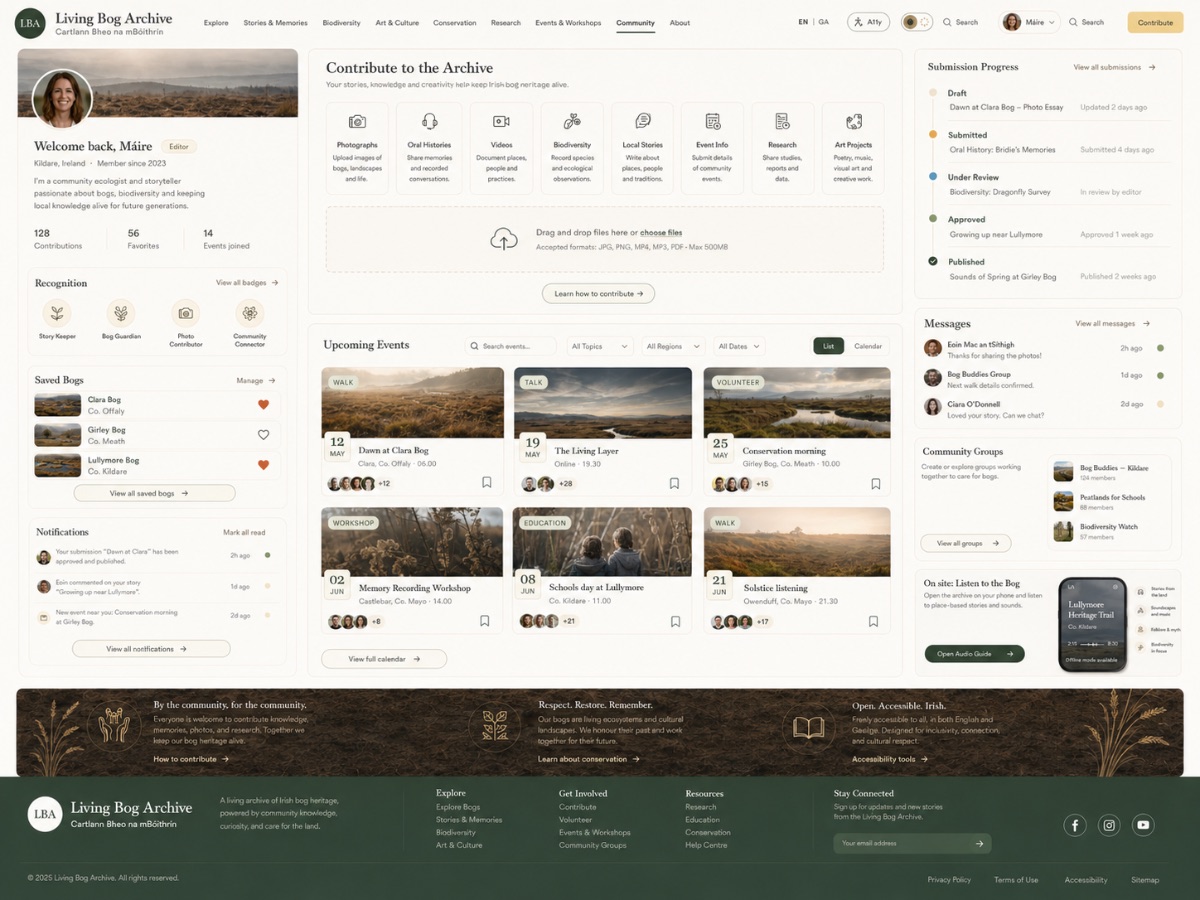
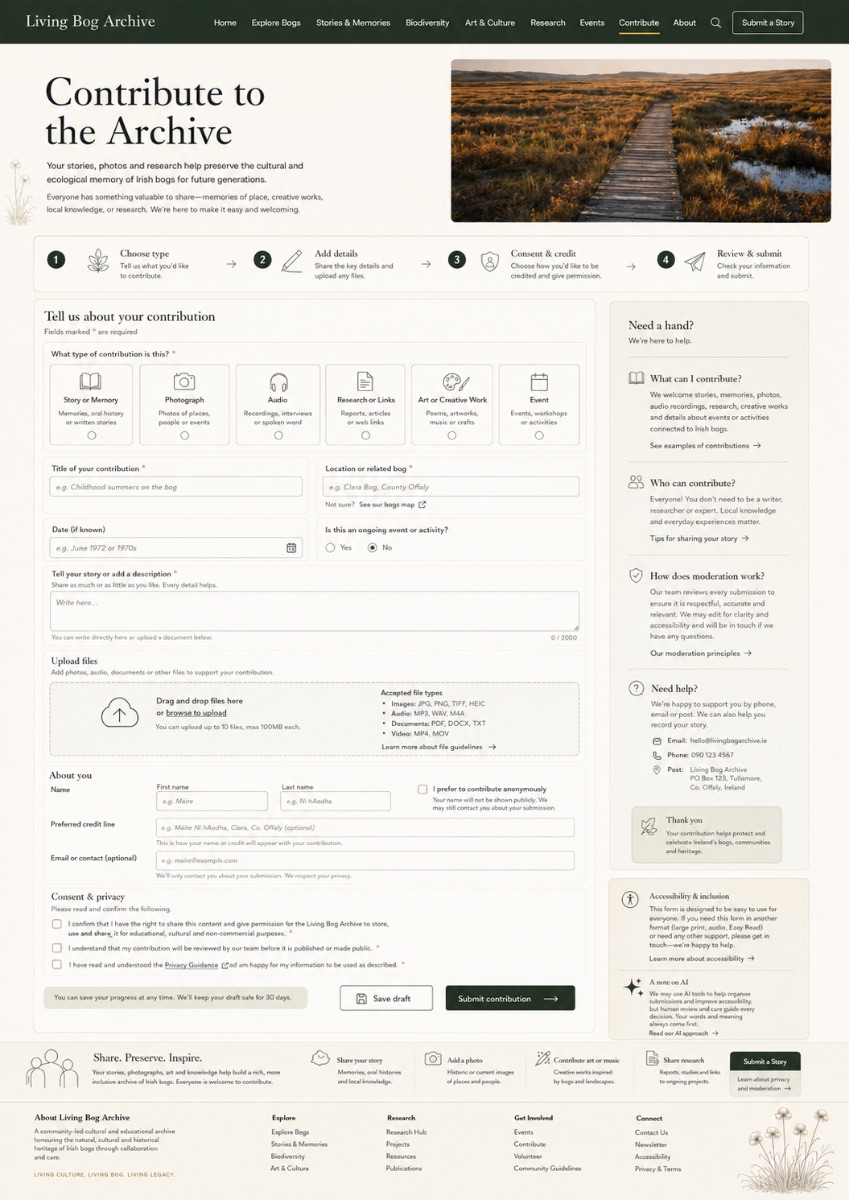
Local knowledge is central to preserving cultural heritage, and the only way an archive like this stays alive and grows over time.
Why a modular content system?
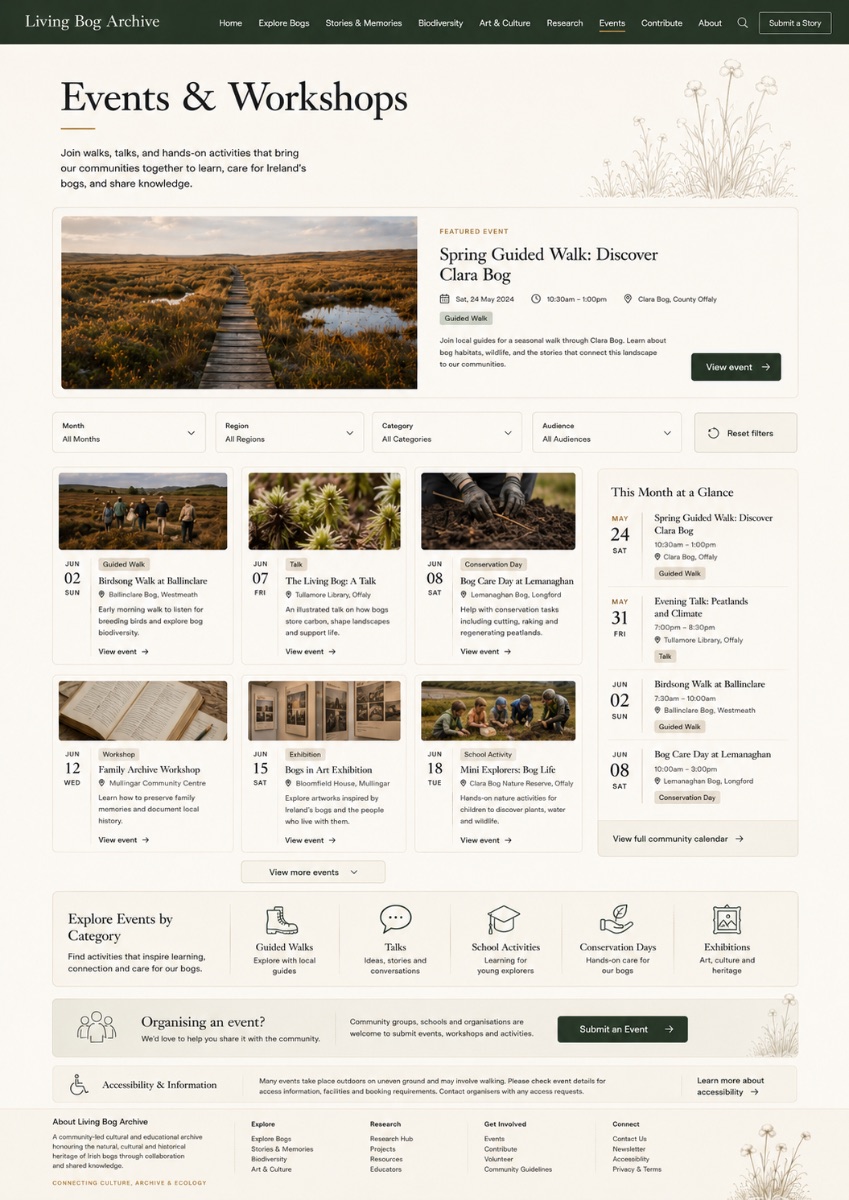
The archive needs to support stories, biodiversity, research, events and photography within the same ecosystem, without forcing each into the same template.
Why editorial storytelling?
Narrative structures improve learning and engagement, helping a newcomer understand not just what the bogs are, but why they matter.
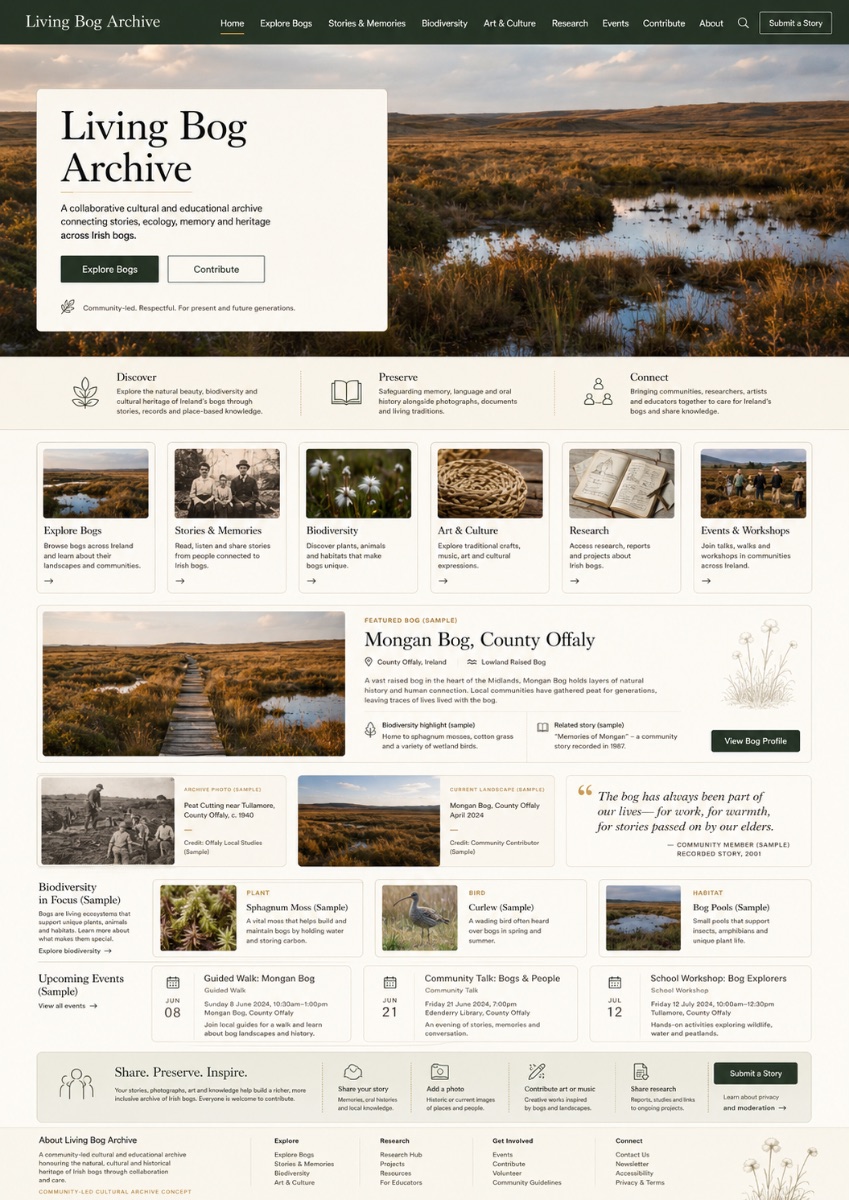
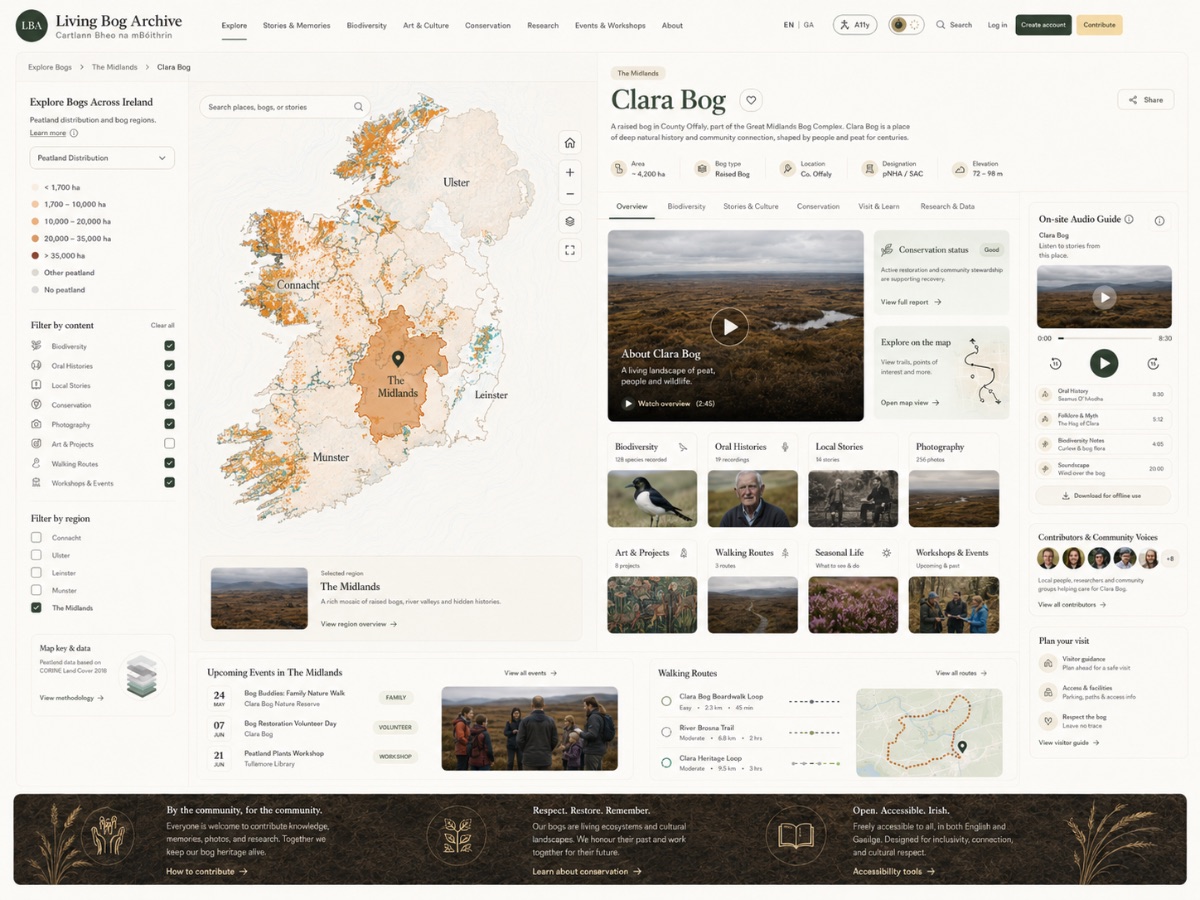
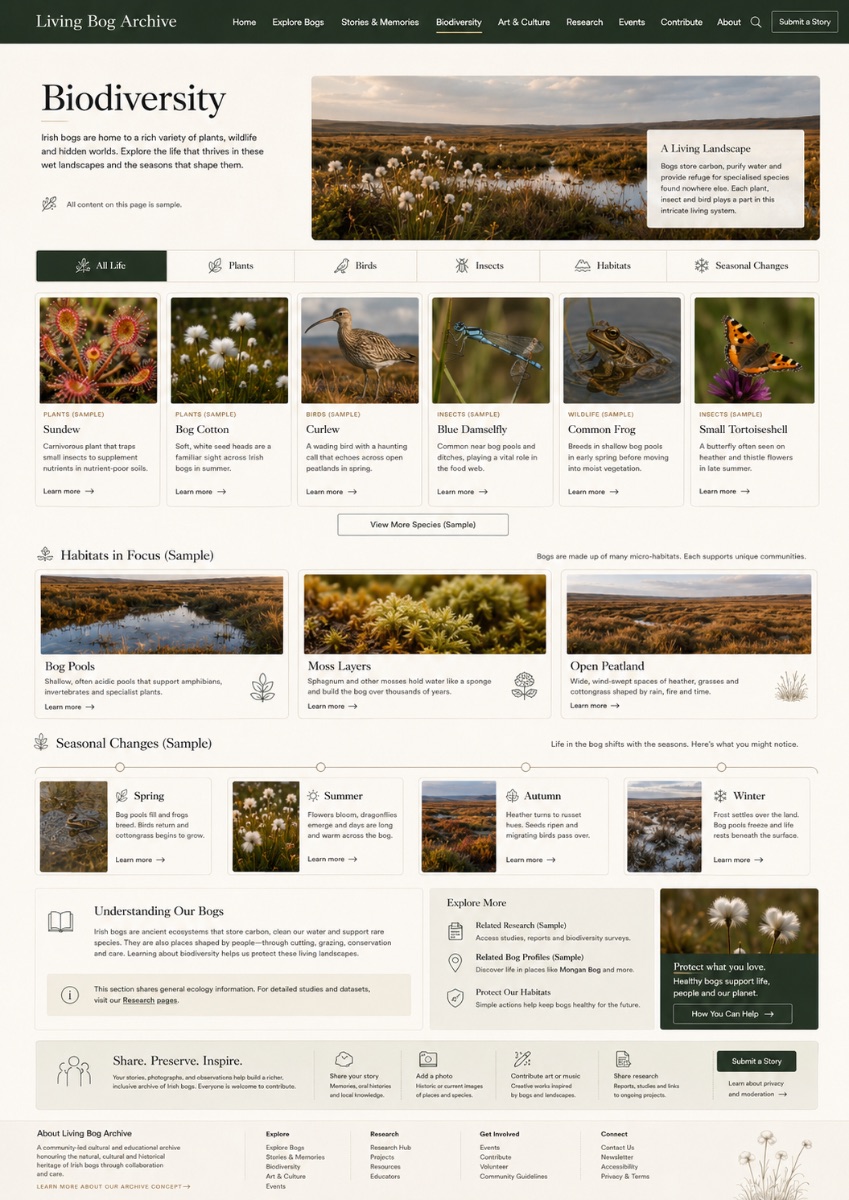
The final outcome: a scalable, reading-first archive spanning heritage, place, biodiversity, events and community contribution. Click any screen to view it full size.
Accessibility-first
Inclusive design, clear navigation and strong readability built in from the start, not retrofitted.
Clear structure
A predictable hierarchy and consistent patterns so every audience can find their way without prior knowledge.
Human moderation
Community-contributed content is reviewed by people, keeping the archive accurate and culturally respectful.
Transparency
AI-assisted outputs are clearly understood as drafts, with final editorial decisions made and owned by a human.
Responsible AI
AI used as a collaborator within boundaries, accelerating work without outsourcing judgement or accountability.
Readability
Editorial typography and generous spacing make long-form heritage content calm and easy to read.
AI is most effective as a collaborative design tool, not a decision-maker.
While AI accelerated research, synthesis and exploration, human judgement remained essential for accessibility, cultural sensitivity, community needs and meaningful information architecture. The result is a scalable digital archive designed to preserve and share Irish bog heritage for future generations.